Many cold email templates online come with a promised reply rate. We (Outreach) won't do that. Reply rates depend on who you're writing to, what you offer and how good your list is — and a number without that context tells you nothing about your own campaign.
What we can give you is the reasoning. Below are five B2B cold email templates for the situations sales teams run into most often, each followed by why it's built the way it is. Once you understand the reasons, you can adapt any of them to your market instead of copying words that were written for someone else's.
The templates use placeholders in {{double_braces}}. Replace every one of them — an email that arrives with {{first_name}} still in it tells the reader exactly how much attention they're getting.
What makes a B2B cold email work?
Relevance to the reader, one clear request, and an easy way to say no. Everything else — length, tone, subject line — serves those three.
A few principles run through every template below:
- Lead with them, not you. The first line should show you know something specific about the reader's company. "We're a leading provider of..." is about you.
- One ask per email. A reader who has to choose between "book a call," "check out our deck" and "forward this to the right person" often does none of them.
- Make the reply small. "Would it be worth a 15-minute call?" can be answered with one word. "Let me know your thoughts" can't.
- Be honest in the subject. The subject should describe what the email is actually about. Tricks like a fake "Re:" get noticed the moment the reader reaches the body, and they burn trust you can't win back.
- Always include an opt-out. It gives a reader who isn't interested a better option than the "Report spam" button. Google and Yahoo both tell senders to keep spam rates below 0.3% — more on that in why cold emails land in spam.
What's a good first cold email template?
A short email that names a specific reason you're writing to this company, states one concrete outcome you can offer, and asks one yes-or-no question.
Subject: {{company}}'s {{specific_area}}
Hi {{first_name}},
I saw that {{company}} {{specific_observation — e.g., added a second warehouse in Ohio this spring}}.
We help {{type_of_company}} {{specific_outcome — e.g., cut the time it takes to onboard new suppliers}}. {{One sentence of proof — a named customer or a concrete result you can stand behind}}.
Would it be worth a 15-minute call to see if this fits {{company}}?
{{your_name}} {{title}}, {{your_company}}
{{postal_address}} · If you'd rather not hear from me, just reply "no thanks" and I won't email again.
Why it works:
- The subject names their company and a topic, not your product. It tells the reader what the email is about without pretending to be something else.
- The first line proves this isn't a mass email. A specific observation can only have been written for them.
- One outcome, not a feature list. The reader should be able to repeat what you do in one sentence after reading it once.
- Proof you can defend. A real customer name or a result you can document beats an adjective. If you don't have one yet, leave the line out rather than invent it.
- The footer does two jobs. The postal address shows the reader you're a real company, and the plain-language opt-out gives an unhappy reader an alternative to the spam button.
How should you follow up after no reply?
Send a short follow-up that adds one new piece of information and makes it just as easy to say "not interested" as "yes." A follow-up that only says "just bumping this up" gives the reader no new reason to answer.
Subject: {{same subject as your first email}}
Hi {{first_name}},
One more thought on {{company}}'s {{specific_area}}: {{new, useful piece of information — e.g., a short example of how a similar company handled the same problem}}.
If it's not a priority right now, a quick "not now" is completely fine — I'll close the loop on my side.
{{your_name}}
{{postal_address}} · Reply "no thanks" to stop hearing from me.
Why it works:
- It keeps the original subject. The reader sees both emails in context, so you're continuing a conversation — not disguising a new email as a reply with a fake "Re:".
- It adds value instead of pressure. A new example or insight gives a reason to reply that the first email didn't.
- "Not now" is an invited answer. A clear no is useful: it tells you to stop, and it's far better for you than silence followed by a spam report.
- It still carries the opt-out. Every email in the sequence gives the reader the same easy way out, not just the first.
How many follow-ups, and how far apart? No mailbox provider publishes a rule, and we won't invent one. A reasonable test: if you'd feel uncomfortable receiving the sequence yourself, it's too many.
How do you cold email a Korean company from abroad?
Keep it short, open and close with a Korean greeting, give times in Korea Standard Time, and start the subject with "(광고)", Korean for "(Advertisement)." Outreach adds that label automatically when you send to Korean businesses, so you only need to write the rest of the subject.
Subject: (광고) {{your_company}} — {{topic in plain English}} / {{topic in Korean, if you can write it accurately}}
{{company}} {{recipient_title — e.g., 담당자님}}께,
안녕하세요. (Hello.)
I'm {{your_name}} from {{your_company}} in {{country}}. {{One line on why you're writing to this company specifically — e.g., something you saw on their website}}.
{{One or two sentences: what you offer and why it's relevant to the Korean market or their business specifically.}}
Would you be open to a short video call? I'm available {{times in Korea Standard Time, KST}}.
감사합니다. (Thank you.) {{your_name}}
{{your_company}} · {{email}} · {{phone}} · {{postal_address}} 수신을 원하지 않으시면 이 메일에 "수신거부"라고 회신해 주세요. / To stop receiving these emails, reply "unsubscribe."
Why it works:
- "(광고)" comes first in the subject. Outreach puts it there automatically for emails going to Korean businesses, so the words after it should carry the topic.
- The greeting follows Korean business convention. "담당자님께" means roughly "To the person in charge," and "{{name}} 대표님" is used for a company head. "안녕하세요" (hello) and "감사합니다" (thank you) are standard and polite. A short Korean greeting shows effort; if you can't write natural Korean, keep the rest in clear, simple English rather than an awkward machine translation.
- Name, email, phone and address are all in the footer. A reader who has never heard of your company can see at a glance who you are and how to reach you another way.
- The opt-out is in Korean and English. The reader may not be comfortable in English, so the way out is written in both.
- Times are in KST (UTC+9). It saves the reader converting time zones, and shows you've thought about their working day.
How do you write a referral introduction email?
Name the person who referred you in the first line, say why they thought you should talk, and keep the ask small. A referral works because it borrows trust — so it only works if it's real.
Subject: {{referrer_name}} suggested I get in touch
Hi {{first_name}},
{{referrer_name}} at {{referrer_company}} suggested I reach out. {{He/She/They}} mentioned that {{company}} is {{specific situation the referrer described}}.
We worked with {{referrer_company}} on {{what you did together}}, and {{referrer_name}} thought a similar approach might be useful for you.
Would a 15-minute call next week be worthwhile? If the timing's wrong, no problem at all.
{{your_name}}
{{postal_address}} · Reply "no thanks" and I won't follow up.
Why it works:
- The referrer's name is in the subject and the first line. It's the most important fact in the email, so it goes where the reader looks first.
- It explains the connection. "They suggested I reach out" is stronger when the reader can see why.
- It depends on permission. Only use someone's name if they've agreed. If the recipient checks with the referrer and finds out they didn't, you've lost both relationships.
A variation: ask the referrer to send a short introduction email to both of you. Then your first message is a reply in a thread the recipient already expects.
What should you send after meeting someone at a trade show?
A follow-up that reminds them exactly where and how you met, refers to something specific you discussed, and sends what you promised.
Subject: Following up from {{event_name}} — {{what you promised to send}}
Hi {{first_name}},
Thanks for stopping by our booth at {{event_name}} on {{day}}. You mentioned {{specific thing they said — e.g., that you're reviewing packaging suppliers for next season}}.
As promised, here's {{the thing you promised — e.g., the spec sheet for our recyclable trays}}: {{link or attachment}}.
If it would help, I can {{one concrete next step — e.g., send samples to your office}}. Just let me know.
{{your_name}}
{{postal_address}} · Reply "no thanks" and I'll take you off my list.
Why it works:
- The subject names the event. People meet dozens of exhibitors at a show; the event name tells them instantly why you're writing.
- A detail from the conversation proves you listened. It separates you from every exhibitor sending the same "great to meet you" email.
- It delivers what was asked for. Information the recipient asked for is the email they're most likely to read, so don't dilute it with unrelated promotion.
- The next step is optional and concrete. "Let me know" is enough when you've given them something specific to say yes to.
What should you check before sending any of these templates?
That the address is real and that your domain is authenticated. Two quick checks:
- Is the address real? Sending to addresses that don't exist creates bounces. Our free email address checker asks the recipient's mail server whether an address exists; see how to verify an email address for what the results mean.
- Is your domain authenticated? Google and Yahoo require SPF or DKIM from every sender. Our free mail authentication checker looks up your records, and our SPF, DKIM and DMARC guide shows how to set them up.
(Our free checkers' interfaces are currently in Korean, but each one only needs an email address or your email text.)
How do you send these templates with Outreach?
Paste a template into the message step of an Outreach project, and the placeholders for each business are filled in for you. Finding the businesses, sending, and following up all happen in the same project.
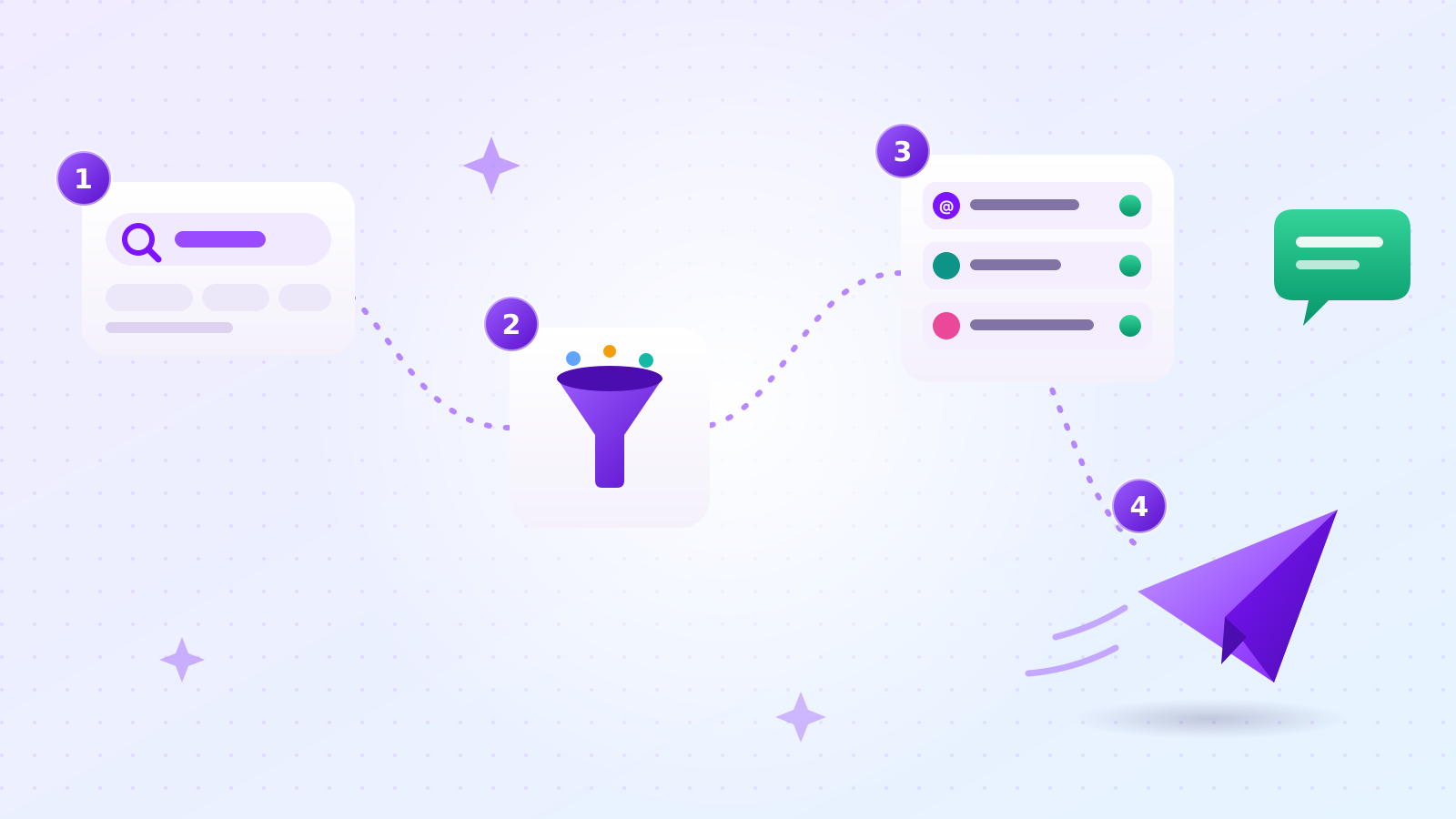
- Build the list. Create a project, choose domestic or international, pick a country and region, and type your industry keywords with a target count. Outreach collects each business's email, phone number, and Instagram handle and puts them on one row of a results table. Addresses that don't exist aren't saved.
- Write the message. Paste the first template into the message editor. Fields like the business name are filled in automatically for each recipient. The line that proves you looked at their company — the specific observation — is still yours to write from something you actually saw.
- Send. Send now or schedule it for later. Emails go out from your own connected Gmail, one at a time with a pause of about 10 minutes between them, so nothing goes out in a burst.
- Follow up. Send a follow-up like the second template to the businesses you've already emailed, or set automatic follow-ups that go to businesses that haven't replied, at an interval you choose.
Afterward, each project shows a simple funnel — businesses collected, emails sent, replies received — so you can compare how different wording performs by the replies it gets. Pricing is per contact detail found, with no monthly subscription and free credits on signup.
The short version
- A good B2B cold email is specific to the reader, asks for one small thing, and makes "no" easy.
- Follow-ups should add something new and keep the original subject — never a fake "Re:".
- For Korean companies: open with a short Korean greeting, start the subject with "(광고)", include name, email, phone and address, and write the opt-out in Korean and English.
- Referrals only work with the referrer's permission; trade show follow-ups should send what you promised.
- Every email should carry an easy opt-out — it's the reader's alternative to the spam button.